
- There are no more items in your cart
- Shipping
- Total £0.00
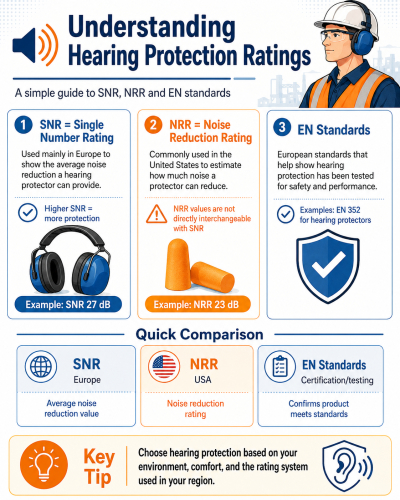
SNR (Single Number Rating) is the European standard for measuring how much noise a hearing protector blocks, defined under EN 352 and ISO 4869-2. NRR (Noise Reduction Rating) is its U.S. equivalent, mandated by the EPA. Both are single-number decibel values, but they use different test methods — SNR values typically run 3–5 dB higher than NRR for the same product. Neither rating guarantees real-world protection unless the device is worn correctly and consistently.
Pick up a pair of earplugs in the UK and you'll find a number on the packet — SNR 28, SNR 32, or something similar. Buy the same style of earplug in the US and you'll see NRR instead. Both numbers claim to tell you how much noise the protector blocks. So why are they different? And which one should you trust?
These ratings are more than just packaging numbers. According to the UK Health and Safety Executive (HSE), an estimated 15,000 workers suffer from work-related hearing problems each year (averaged across 2022/23–2024/25). Noise-induced hearing loss is permanent — once it's gone, it doesn't come back. Choosing the right protection, and understanding what those ratings actually mean, is one of the most practical steps anyone can take to prevent it.
This guide breaks down SNR, NRR, and the EN standards behind them — plainly, accurately, and in a way that makes the numbers usable.
What does noise actually do to your hearing?
Before getting into ratings, it helps to understand the scale you're working with. Noise is measured in decibels (dB), a logarithmic scale — meaning each 3 dB increase roughly doubles the sound energy reaching your ears.
A normal conversation sits at around 60 dB. Busy traffic reaches 80–85 dB. Power tools and heavy machinery regularly exceed 90 dB. At these higher levels, the risk of permanent hearing damage depends on both volume and duration. Under the UK's Control of Noise at Work Regulations 2005:
- 80 dB — employers must provide information and training (lower action level)
- 85 dB — hearing protection must be provided and worn (upper action level)
- 87 dB — the legal exposure limit, even with protection in place
Because of the logarithmic nature of decibels, safe exposure time halves with every 3 dB increase above 85 dB. That means 8 hours is safe at 85 dB, 4 hours at 88 dB, 2 hours at 91 dB, and just 1 hour at 94 dB. A lawnmower, a jazz concert, a busy building site — all of these can cause damage over a working day without the right protection.
Signs that noise levels may be too high include needing to raise your voice to speak to someone nearby, ear discomfort or pain during exposure, ringing (tinnitus) afterwards, or muffled hearing that takes time to clear.
What is SNR (Single Number Rating)?
SNR is the European standard rating for hearing protection, defined under ISO 4869-2 and used across EU and UK markets.
SNR stands for Single Number Rating. It represents the average noise reduction a hearing protector provides across the frequencies most relevant to human hearing, measured under laboratory conditions. The higher the SNR, the greater the attenuation. An earplug or earmuff with an SNR of 30, for example, will typically reduce a 100 dB noise environment to around 70 dB at the wearer's ear.
According to the Royal National Institute for Deaf People (RNID), most industry-standard earplugs carry an SNR of between 25 and 32 dB. To use SNR in practice, simply subtract the SNR value from the measured ambient noise level. If your workplace sits at 98 dB and you're wearing earplugs with SNR 28, the estimated level at the ear is 70 dB — within the recommended safe zone.
Every CE-marked hearing protector sold in Europe is required to display its SNR value. This is because EN 352 — the European standard series governing hearing protectors — mandates testing and labelling as a condition of market entry. EN 352-1 covers earmuffs; EN 352-2 covers earplugs. Both require manufacturers to calculate SNR using attenuation data gathered per EN 13819 and ISO 4869-1.
What are H, M, and L values?
Alongside the SNR, European hearing protectors also display H, M, and L values. These describe the device's protective performance across three frequency bands:
- H (High): 2,000–8,000 Hz — covers high-pitched sounds and machinery whine
- M (Medium): 1,000–2,000 Hz — covers speech range and mid-frequency industrial noise
- L (Low): 63–1,000 Hz — covers low-frequency rumble from engines, generators, and press shops
HML values are particularly useful when the noise environment has a dominant frequency characteristic. A protector with a high L value performs well against low-frequency industrial noise, even if its overall SNR appears similar to another product. For environments such as boiler houses, generator test bays, or concrete shaker tables, the HSE recommends going beyond the SNR and using HML or octave-band calculations for more precise selection.
What is NRR (Noise Reduction Rating)?
NRR is the U.S. equivalent of SNR, mandated by the Environmental Protection Agency (EPA) for all hearing protectors sold in the United States.
NRR (Noise Reduction Rating) serves the same practical purpose as SNR — it tells you, in a single number, how many decibels of protection a device provides under laboratory conditions. Like SNR, a higher NRR means more noise reduction. An earplug rated NRR 33 is expected to block more sound than one rated NRR 25.
The testing methodology differs, though. U.S. NRR values are derived from ANSI S3.19, an older testing standard using experimenter-fit procedures — where trained technicians ensure the best possible fit during testing. The calculation subtracts two standard deviations from the average attenuation across frequencies, plus an additional 3 dB safety offset. This means the published NRR is designed to be achieved by approximately 98% of users under ideal conditions.
Using NRR in practice: OSHA recommends the "NRR minus 7" correction for real-world use. Subtract 7 from the NRR, then subtract the remainder from the ambient noise level to estimate the actual protected exposure. For example, a worker exposed to 100 dBA wearing earplugs rated NRR 33: 100 − (33 − 7) = 74 dBA. NIOSH goes further, recommending that NRR values be derated by 50% or more for field estimates, particularly for earplugs, to account for real-world fit variation.
How do SNR and NRR differ — and can you convert between them?
SNR and NRR are not directly interchangeable. The key differences are:
|
Feature |
SNR |
NRR |
|---|---|---|
|
Region |
Europe / UK |
United States |
|
Standard |
EN 352 / ISO 4869-2 |
ANSI S3.19 / EPA |
|
Safety margin |
~1 standard deviation (~84% of users) |
~2 standard deviations (~98% of users) |
|
Typical value |
~3–5 dB higher than NRR |
~3–5 dB lower than SNR |
Because NRR incorporates a larger built-in safety margin, SNR values tend to come out higher for the same product. An earmuff rated NRR 25 in the US might carry an SNR of approximately 28–30 in Europe. There is no fixed conversion formula — the best practice is to use each rating within its own regulatory context rather than attempting to convert.
Both systems share a critical limitation: they are based on laboratory conditions, with well-fitted protectors on trained subjects. Neither SNR nor NRR accounts for improper insertion, intermittent removal, anatomical variation, or wear time. The ISO standard that underpins both systems explicitly notes that ratings are only valid when protectors are worn in the same manner as during testing.
How to choose the right hearing protection for your environment
Selecting hearing protection is about matching the protector's rating to the noise level — without over- or under-protecting.
The UK's HSE recommends a simple SNR selection guide based on the noise level during a specific work task (not the daily average):
|
A-weighted noise level (dB) |
Recommended SNR |
|---|---|
|
85–90 dB |
20 or less |
|
90–95 dB |
20–30 |
|
95–100 dB |
25–35 |
|
100–105 dB |
30 or more |
The HSE also advises deducting 4 dB from the manufacturer's predicted protection level to account for real-world use. Critically, protectors should not reduce the noise at the ear below 70 dB. According to the HSE, over-protection below this threshold can prevent workers from hearing speech and warning signals, create a sense of isolation, and ultimately lead people to remove their protection — which is far more dangerous than a slightly lower-rated device worn consistently.
When noise environments involve significant low-frequency content (such as press shops, boiler rooms, or engine bays), the HML method provides more accurate selection guidance than SNR alone. In extreme noise above 105–110 dB, combining earplugs and earmuffs may be necessary — though the protection gain is approximately 5 dB, not additive.
Types of hearing protection and when to use each
- Disposable earplugs: Made from foam, mineral wadding, or soft silicone; suitable for most industrial settings; require correct rolling and insertion technique
- Reusable earplugs: Made from foam, soft plastic, or rubber; washable and hardwearing; practical for regular use
- Custom-moulded earplugs: Individually fitted to the ear canal; offer better comfort and attenuation for long-term daily use
- Music earplugs: Use acoustic filters to reduce volume without distorting sound quality; suitable for concerts, festivals, and live music environments
- Ear defenders (earmuffs): Hard cups sealed against the head with cushioned rims; offer comparable protection to earplugs; easier to fit and remove quickly
- Canal caps: Attached to a headband; useful where noise is intermittent and the wearer needs to remove and reinsert protection frequently
The RNID recommends choosing earplugs with an SNR of at least 20 dB for genuine hearing protection. Many earplugs sold in pharmacies and sports shops are designed for swimming or general comfort — not noise reduction — and will not meet this threshold.
Protecting hearing starts with understanding the numbers
SNR and NRR both serve the same purpose: giving workers, safety managers, and PPE buyers a standardised way to compare hearing protectors. SNR applies in Europe and the UK, backed by EN 352 and ISO 4869-2. NRR applies in the United States, governed by ANSI S3.19 and the EPA. SNR values run approximately 3–5 dB higher than NRR for the same product, due to differences in test methodology and safety margins.
Neither rating is a guarantee of real-world performance. The single most important factor in hearing protection is consistent, correct use. A well-fitted SNR 28 earplug worn all day offers far more protection than an SNR 35 device removed every 20 minutes. Combine the right rating with proper training, regular fit checks, and periodic audiometric monitoring — and noise-induced hearing loss, despite being permanent, remains entirely preventable.
Frequently asked questions
What is the difference between SNR and NRR for hearing protection?
SNR (Single Number Rating) is the European standard used in the UK and EU, defined under EN 352 and ISO 4869-2. NRR (Noise Reduction Rating) is the US equivalent, mandated by the EPA under ANSI S3.19. Both express noise reduction in decibels, but NRR uses a larger built-in safety margin, so SNR values for the same product are typically 3–5 dB higher than NRR values.
How do I use the SNR value to select the right hearing protection?
Subtract the SNR value from the measured noise level (in dB) to estimate the noise reaching the ear. For example, SNR 28 in a 100 dB environment gives approximately 72 dB at the ear. The UK HSE recommends targeting a protected level of 70–80 dB and advises deducting 4 dB from the manufacturer's predicted protection value to account for real-world use.
Can you convert SNR to NRR?
There is no exact conversion formula between SNR and NRR. As a rough estimate, SNR values run approximately 3–5 dB higher than equivalent NRR values due to different calculation methods. The best practice is to use each rating within its intended regulatory context — SNR for EU/UK compliance, NRR for US compliance.
What does EN 352 mean on hearing protection packaging?
EN 352 is the European standard series for hearing protectors. A product marked EN 352 has been tested and certified to meet EU and UK safety requirements. EN 352-1 applies to earmuffs; EN 352-2 applies to earplugs. All CE-marked hearing protectors sold in Europe must comply with EN 352 and display their SNR and HML values.
What is overprotection in hearing protection, and why does it matter?
Overprotection occurs when a hearing protector reduces the noise at the ear below approximately 70 dB. According to the HSE, this level of attenuation can prevent workers from hearing speech, warnings, and signals — creating safety risks and causing people to remove their protection. Choosing a protector with an appropriately matched SNR is just as important as choosing one that's rated high enough.
Does doubling up earplugs and earmuffs double the protection?
No. Combining earplugs and earmuffs does not double the noise reduction. The two devices together typically provide approximately 5 dB more protection than either alone, due to the limits of how sound transmits through bone and tissue. Dual protection is recommended only for extremely high noise environments (above 105–110 dB).
What SNR rating do I need for a concert or music festival?
For a venue averaging 99 dB, an earplug with an SNR of 19–21 dB would reduce the level at the ear to approximately 78–80 dB — within a safe range. Music earplugs with acoustic filters are designed to reduce volume evenly across frequencies, preserving sound quality while still protecting hearing.
(51) (0)
 Whatsapp


